Место работы автора, адрес/электронная почта: Северо-Восточный федеральный университет им. М. К. Аммосова, Кафедра философии ; 677013, г. Якутск, ул. Кулаковского, 42 ; e-mail: vs.danilova@s-vfu.ru ; https://www.s-vfu.ru/
Ученая степень, ученое звание: д-р филос. наук, канд. физ.-мат. наук
Область научных интересов: Онтология и теория познания, история и философия науки, ноосферогенез
ID Автора: SPIN-код: 9303-7094, РИНЦ AuthorID: 29533
Деятельность: В 1970-1998 гг. - стажер-исследователь, аспирант, научный сотрудник Института космофизических исследований и аэрономии. С 1999 г. работает в Якутском государственном университете им. М. К. Аммосова.
Количество страниц: 7 с.
Данилова, В. С.
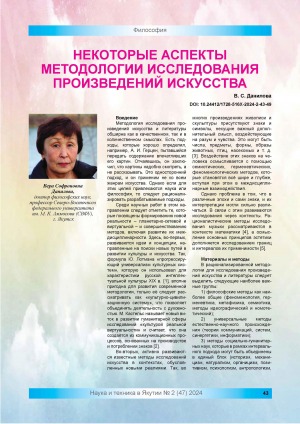
Некоторые аспекты методологии исследования произведений искусства / В. С. Данилова ; Северо-Восточный федеральный университет им. М. К. Аммосова // Наука и техника в Якутии. - 2024. - N 2 (47). - C. 43-49. - DOI: 10.24412/1728-516Х-2024-2-43-49
DOI: 10.24412/1728-516Х-2024-2-43-49

Количество страниц: 10 с.
The main characteristic features of Russia’s identity are integrity, self-sufficiency, uniqueness, and self-development. In addition, the parameters included in these characteristic features are identified, such as universality and harmony for integrity, genesis, formation for self-sufficiency, attempts to express it in Pochvennichestvo and Slavophilism. Uniqueness is characterized by vivid literary features that cannot be confused with anything else and “living life” (V.V. Veresaev’s term) as the embodiment of human existence in literature. Self-development of Russian classical literature was determined by: the desire for practical embodiment of spirituality in the aspirations of the people, in the formation of the soul, reliance on a deep synthesis of various genres, each of which also went through its stages of formation, contrasts and contradictions associated with the fundamental principle of dialectical development - “interaction of opposites”. The development of ideas about identity in socio-political sciences complements the ideas developed in this work. Identification of the individual in Russian literature goes through the limits of perception of the world and being, which were touched upon by many Russian writers and, above all, Dostoevsky, Saltykov-Shchedrin, Leskov, Chekhov, and these were completely different limits. The identity of Russia, which is based on the identification of literature is quite easily substantiated and has great prospects. Its substantiation has visual consistency, clarity, rationality, and evidence. In addition, it has great prospects because literature can penetrate almost everywhere - into any social and humanitarian sphere. It easily interacts with music, painting, theater, and, according to leading modern philosophers, begins to replace philosophy. In our opinion, a new type of synthesis of literature and philosophy is beginning to form.
Кожевников, Н. Н.
Идентичность России в контексте её классической литературы второй половины XIX столетия / Н. Н. Кожевников, В. С. Данилова ; Северо-Восточный федеральный университет им. М. К. Аммосова // Вестник Северо-Восточного федерального университета им. М. К. Аммосова. - 2025. - N 2 (38). - С. 77-86. - DOI: 10.25587/2587-5604-2025-2-77-86
DOI: 10.25587/2587-5604-2025-2-77-86

Количество страниц: 12 с.
The aim of the work is to identify the fundamental principles and approaches to the methodology of art and literature research and to demonstrate the capabilities of rational methods (with elements of irrationality) for these purposes. The most important groups of this methodology are philosophical methods: phenomenology, hermeneutics, ideographic, nomothetic, methods of metaphysics, dialectics, semiotics; universal methods of natural scientific origin: theories of communications, systems, synergetic, computer science; methods of social and humanitarian sciences based on: historicism, mechanism, naturalism, organicism, psychologism, anthropologism, structuralism, scientism, evolutionism, formalism, functionalism, positivism; methods of literary criticism and cultural studies; methods of sociology and social philosophy. These methods are applied to the main stages of art development and to the most important trends and styles of art in various combinations and depending on the intervals of their applicability. The main approaches of the methodology under study are the synthesis of the majority of existing methods within the all sphere of the art and literature, or within its type, genre or style; a series of methodological approaches are identified that ensure the interaction of one method with another, the identification of systems and subsystems of these methods for specific research conditions. Interaction of the methodology used by the creator of works and the methods of perception of his works (that is, the interaction of ontological and epistemological approaches to creation and research). It is argued that the rationalized methodology of studying works of art and literature has significant prospects. Using various types of synthesis in different genres and between them, it is possible to obtain a single, holistic picture of the perception of works. Reliance on the limits of perception, usually associated with the great mysteries of outstanding works of art and literature, is similar to the limits on which the methodology of science or religious revelations is based and allows us to link the rational with the irrational in this process of cognition. Another promising direction is associated with the improvement of the known methods of studying works of art and literature: semiotics, hermeneutics, sociology, cultural studies, communication theory, depending on the characteristic features of a particular work. The evolution of these methods also strives for unity, integrity and mutual complementarity of the entire process of cognition of works of art and literature.
Данилова, В. С.
Методология исследования произведений искусства и литературы / В. С. Данилова ; Северо-Восточный федеральный университет им. М. К. Аммосова // Вестник Северо-Восточного федерального университета им. М. К. Аммосова. - 2025. - N 2 (38). - С. 65-76. - DOI: 10.25587/2587-5604-2025-2-65-76
DOI: 10.25587/2587-5604-2025-2-65-76

Количество страниц: 10 с.
In the philosophy of mathematics, two opposing trends have historically developed: apriorism (Pythagoras) and empiricism (Aristotle) and both of them have had their impact on the development of music. Philosophers of Ancient Greece and the East noted the important role of music; it was used in religious rites, which served as the basis for social and state relations. The article presents a joint panorama of the development (by historical eras) of the philosophy of mathematics and music and notes their close relationship. But if the Philosophy of Mathematics has long been included in the section of sciences "Philosophical Questions of Science", the Philosophy of Music has not yet acquired such a full-fledged status, although philosophers, specialists in aesthetics, art criticism, composers and musicians have dedicated their works to it. This can be attributed to the fact that since the time of Pythagoras, science has not advanced much in explaining the phenomenon of music. The article attempts to explain this paradox and offer as a hypothesis possible options for studying this topic "Mathematics and Music". The development of brain sciences, high technologies and cognitive sciences can contribute to the success in the development of the Philosophy of Music. The philosophy of music explores ontological, epistemological and axiological problems, the essence, historical and social existence of music, as well as the features of its interaction with art, literature, mathematics, natural and humanitarian sciences. Applied issues of the philosophy of music are the formation of ethical and cognitive guidelines for life and ideological ideals in humans. Music finds its practical embodiment in medicine, psychology, education and various means of communication. The latter is becoming the most important direction of modern philosophy and science. At present, mathematics contributes to the development of new integral directions in music associated with light, color and many other characteristics.

Издательство: Издательский дом СВФУ
Год выпуска: 2025
Количество страниц: 306 с.

Год выпуска: 2022

Количество страниц: 2 с.
Данилова, В. С. Республиканская студенческая конференция "Философия и методология научных исследований" / В. С. Данилова, Н. Н. Кожевников ; Северо-Восточный федеральный университет им. М. К. Аммосова // Вестник Северо-Восточного федерального университета им. М. К. Аммосова. Серия "Педагогика. Психология. Философия" - 2024. - N 4 (36). - С. 204-205. - DOI: 10.25587/2587-5604-2024-4-204-205
DOI: 10.25587/2587-5604-2024-4-204-205

Количество страниц: 8 с.
Aesthetics is a special area of philosophy and science, where many questions arise, primarily methodological ones. Controversial issues of the methodology of aesthetics were considered in the New Time by outstanding philosophers. On this basis, the authors explore the limits of the possibilities of aesthetic methodology, the main provisions and conclusions of the preliminary consideration of the problem. The authors formulate the contours of the methodology of aesthetics, which boil down to identifying its boundaries and basic principles. The methodology should be synthetic, including different methods and approaches that are not combined all at once, but are used separately in certain circumstances for specific tasks. However, they can constitute separate stages of ascent to the solution of the problem under consideration, or be within the boundaries in which their own separate method is used. Nevertheless, these methods constitute a single whole, due to the consonance of rhythms, their general synergy. Of great importance can be the two-chambered methodological approach, which should separate the creative process and the essential core of the work from its research and interpretation. The latter can be both rational and based on various forms of "empathy", compassion, use the developed approaches and techniques of hermeneutics and phenomenology. The key problem in aesthetic methodology is the problem of aesthetic value, which should be considered as based on a set of rhythms that link the methods used into a single whole. They correspond to various rhythms based on the "interval method" of the humanities (each interval has its own approach). This also corresponds to the relative value of individual works, which can weaken or increase over time.
Кожевников, Н. Н. О методологии эстетики / Н. Н. Кожевников, В. С. Данилова ; Северо-Восточный федеральный университет им. М. К. Аммосова // Вестник Северо-Восточного федерального университета им. М. К. Аммосова. Серия "Педагогика. Психология. Философия" - 2024. - N 4 (36). - С. 182-189. - DOI: 10.25587/2587-5604-2024-4-182-189
DOI: 10.25587/2587-5604-2024-4-182-189

Количество страниц: 4 с.
Кожевников, Николай Николаевич.
Этические аспекты искусственного интеллекта / Н. Н. Кожевников, В. С. Данилова // Наука и техника в Якутии. - 2020. - N 2 (39). - С. 28-31. Библиогр.: с. 31 (3 назв.).
DOI: 10.24412/1728-516X-2020-2-28-31

Количество страниц: 10 с.
The investigation of Russian folklore has not yet been fully institutionalized in literature, cinema, and theater. In Russian literature, for example, there are no novels about Koshchei the Immortal, Ivan the Prince, heroes of Slavic pagan culture and many other characters of this genre. Meanwhile, these are deep, colorful images organically integrated into an equally vivid context. Many great writers, such as Thomas Mann, have written about such gaps. The goal is to identify the main typological characteristics of the Russian epic, which, in our opinion, has been studied in this sense very one-sidedly. The methodology is a comparative analysis of various approaches (mythological, historical, structural, etc.) closely interconnected with the characteristic features and structure of epics. At the same time, considerable attention is the harmonious combination of various motifs of the epic: heroes, Kalik-passers-by, epic time, pagan influences, hyperbolization, etc. An attempt is made not to accept, but to take into account various influences on such studies (pre-revolutionary, post-revolutionary, inspired by the Marxist approach, structural analysis, which began to be used in the study of Russian epic since the 1970s). The Russian epic, thanks to a huge number of historical, social, and cultural connections, naturally interacts with the epics of the republics (union and autonomous) that were part of the former USSR, which opens up wide opportunities for comparative studies of various types. Paths are outlined for a comparative analysis of the Russian epic with the epics of the East Slavic peoples, as well as with the Yakut heroic epic Olonkho. The authors' further plans involve continuing the study of Russian folklore in the genre of fairy tales and the field of culture of Slavic paganism. The first of them has been studied quite fully, but the structural and systemic approaches to research need to be further developed. The culture of Slavic paganism is a little-studied area where there are still no established approaches, and there are different points of view on many issues. Here you can apply the methodological approaches outlined in our monograph “Philosophy of Olonkho”.
Кожевников, Н. Н. Основания и компаративистский анализ русского эпоса / Кожевников Н. Н., Данилова В. С. ; Северо-Восточный федеральный университетим. М. К. Аммосова // Вестник Северо-Восточного федерального университета им. М. К. Аммосова. Серия "Эпосоведение". - 2024. - N 2 (34). - С. 67-76. - DOI: 10.25587/2782-4861-2024-2-67-76
DOI: 10.25587/2782-4861-2024-2-67-76