Место работы автора, адрес/электронная почта: Институт гуманитарных исследований и проблем малочисленных народов Севера, Отдел якутского языка ; 677027, г. Якутск, ул. Петровского, 1 ; e-mail: igi.ysn@mail.ru ; http://igi.ysn.ru
Ученая степень, ученое звание: канд. филол. наук
Область научных интересов: Фольклорная лексикография
ID Автора: SPIN-код: 9065-0311, РИНЦ AuthorID: 548427
Деятельность: С 2009 г. работает в Институте гуманитарных исследований и проблем малочисленных народов Севера

Количество страниц: 8 с.
The article is devoted to solving the problem of forming a certain structure of a dictionary definition that can sufficiently reveal the connotative meaning of words functioning in the language of the heroic epic Olonkho. The problematic nature of the issue under consideration has many roots and is associated with the prerequisites for the morphogenesis of the artistic system of folk poetic speech, the concepts of “folklore language”, “Olonkho language”, as a specific form of the national language. The subject of discussion touches on the problem of studying the origins of the development of the art of depicting the oral poetic word, denoting almost all the factors associated with the emergence of the phenomenon of “language of oral poetic creativity”. The problem is complicated by the fact that in the practice of folklore lexicography there is no tendency to use methodologies that take into account the peculiarities of the language systems of Turkic-speaking peoples. The article is intended to eliminate the existing white spot in the specified area. The purpose of the article is to conduct an integrative analysis of the lexical-semantic features of the Olonkho language, and to develop the basic principles for the formation of dictionary definitions in the Olonkho language dictionary. The study was conducted on the material of the olonkho text “Nyurgun Bootur the Swift” by K. Orosin as a result of the analysis, the structure of the definition in the Olonkho language dictionary was determined, consisting of a basic and commentary part. The function of revealing folklore connotation is assigned to the commentary part of the definition. The presented scheme for compiling a dictionary definition can be applied to all units of lexicographic description: stable verbal complexes and single lexemes.

Количество страниц: 12 с.
The article presents the result of the procedure for resolving the issue of forming dictionary vocables, as well as organizing a dictionary entry in the dictionary of the language of the Yakut heroic epic Olonkho, proclaimed by UNESCO in 2005 as a masterpiece of the oral and intangible cultural heritage of humanity. The question was one of the rather complex problems in the theoretical development of a dictionary of the Olonkho language. The high degree of formulaicity of the language of the Yakut epic, the originality of the stylistics of the epic narrative and the characteristic features of the language of the Turkic peoples generated a complex of original properties of the Olonkho language, which determined the problematic character of lexicographic works. However, when developing the macro- and microstructure of dictionaries of the language of folklore, an unconventional solution to the problem is allowed, and therefore the work proposes a special structure of a dictionary entry, as well as methods for forming non-standard forms of dictionary vocables. To achieve the goal, we analyzed the functional and semantic features of the lexeme aghys ʻeightʼ in the olonkho text Nurgun Bootur the Swift by K. G. Orosin (1947). As a result of the analysis, the following points were clarified and determined: 1. it was decided to present stable verbal complexes of the Olonkho language (i. e. epic formulas, formulaic constructions, constructions of a formulaic nature), phraseological units, single lexemes and epic periods as vocabulary vocables. The main factors that served as support for making such a decision were the distinctive feature of the Turkic languages - the law of synharmonism, as well as the diffuse nature of the meaning of folk expressions, which requires an integrated approach to the compilation of dictionary definitions, including in the design of the lemma part of the dictionary. The basic principles of the structure of dictionary entries in the Olonkho language dictionary are indicated: the order of presentation of units of lexicographic description, the order of presentation of stable verbal complexes, principles of presentation of material, features of presentation of illustrative material. In developing the described principles, we relied on individual aspects of the theoretical positions expressed in the works of our predecessors, specializing in the field of Russian lingua-folkloristics, Russian folklore lexicography, in Turkic studies, as well as the result of a comprehensive analysis of materials from the K. G. Orosin’s olonkho text of Nurgun Bootur the Swift . In the course of further lexicographical work, it will obviously be possible to make minor adjustments, since the language material of the Yakut epic is extremely diverse. However, the result obtained in this article, in this aspect, will definitely form the basis of lexicography.
Роббек, Л. В.
О формировании вокабул и организации словарной статьи в словаре языка олонхо / Л. В. Роббек ; Институт гуманитарных исследований и проблем малочисленных народов Севера // Вестник Северо-Восточного федерального университета им. М. К. Аммосова. Серия: Эпосоведение. - 2024. - N 1 (33). - С. 45-56. - DOI: 10.25587/2782-4861-2024-1-45-56
DOI: 10.25587/2782-4861-2024-1-45-56
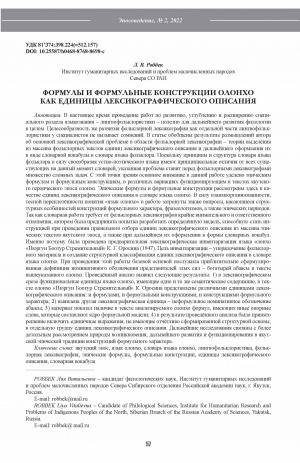
Количество страниц: 10 с.
- Якутский героический эпос Олонхо > Научные труды,
- Общественные науки. Образование > Этнография. Обычаи. Жизнь народа. Нравы,
- Языкознание. Филология. Художественная литература > Языкознание и языки. Лингвистика > Якутский (саха),
- НАУКА ЯКУТИИ > ОБЩЕСТВЕННЫЕ НАУКИ > Этнография. Обычаи. Жизнь народа. Нравы,
- НАУКА ЯКУТИИ > ЯЗЫКОЗНАНИЕ. ФИЛОЛОГИЯ. ЛИТЕРАТУРОВЕДЕНИЕ. ХУДОЖЕСТВЕННАЯ ЛИТЕРАТУРА > Языкознание и языки. Лингвистика.
Роббек, Л. В. Формулы и формульные конструкции олонхо как единицы лексикографического описания / Л. В. Роббек // Вестник Северо-Восточного федерального университета им. М. К. Аммосова. Серия "Эпосоведение" - 2022, N 2 (26). - С. 57-65
DOI: 10.25587/h0468-8768-8698-c
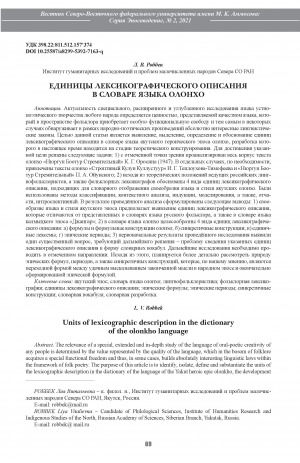
Количество страниц: 10 с.
- Общественные науки. Образование > Этнография. Обычаи. Жизнь народа. Нравы,
- Языкознание. Филология. Художественная литература > Языкознание и языки. Лингвистика > Якутский (саха),
- НАУКА ЯКУТИИ > ОБЩЕСТВЕННЫЕ НАУКИ > Этнография. Обычаи. Жизнь народа. Нравы,
- НАУКА ЯКУТИИ > ЯЗЫКОЗНАНИЕ. ФИЛОЛОГИЯ. ЛИТЕРАТУРОВЕДЕНИЕ. ХУДОЖЕСТВЕННАЯ ЛИТЕРАТУРА > Языкознание и языки. Лингвистика.
Роббек, Л. В. Единицы лексикографического описания в словаре языка олонхо / Л. В. Роббек // Вестник Северо-Восточного федерального университета им. М. К. Аммосова. Серия "Эпосоведение" - 2021, N 2 (22). - С. 69-78.
DOI: 10.25587/a8299-5392-7163-q

Количество страниц: 4 с.
- Общественные науки. Образование > Этнография. Обычаи. Жизнь народа. Нравы,
- Языкознание. Филология. Художественная литература > Литература. Литературоведение,
- НАУКА ЯКУТИИ > ОБЩЕСТВЕННЫЕ НАУКИ > Этнография. Обычаи. Жизнь народа. Нравы,
- НАУКА ЯКУТИИ > ЯЗЫКОЗНАНИЕ. ФИЛОЛОГИЯ. ЛИТЕРАТУРОВЕДЕНИЕ. ХУДОЖЕСТВЕННАЯ ЛИТЕРАТУРА > Литература. Литературоведение.
One of forms of systematization of epithets in olonkho - the classification of key epic objects - has been proposed in the article.
Роббек, Л. В. К вопросу систематики эпитетов в олонхо=On the question of the systematics of epithets in olonkho / Л. В. Роббек // Северо-Восточный гуманитарный вестник. – 2011. – N 1 (2). – С. 87-89.