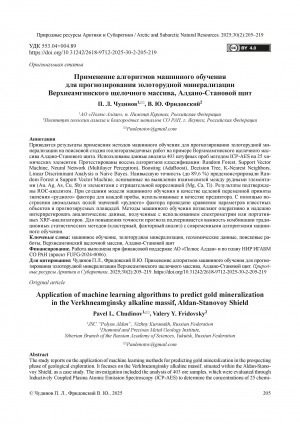
Применение алгоритмов машинного обучения для прогнозирования золоторудной минерализации Верхнеамгинского щелочного массива, Алдано-Становой щит = Application of machine learning algorithms to predict gold mineralizationin the Verkhneamginsky alkaline massif, Aldan-Stanovoy Shield
Статья в журнале
Русский
553.411:004(571.56)
10.31242/2618-9712-2025-30-2-205-219
машинное обучение; золоторудная минерализация; геохимические данные; поисковые работы; Верхнеамгинский щелочной массив; Алдано-Становой щит; machine learning; gold mineralization; geochemical data; exploration; Verkhneamginsky alkaline massif; Aldan-Stanovoy Shield
С. 205-219
Природные ресурсы Арктики и Субарктики = Arctic and Subarctic natural resources: научный журнал
Якутск, Академия наук Республики Саха (Якутия)
Основан в 1996 г.
Выходит 4 раза в год
2618-9712 (print), 2686-9683 (online)
Природные ресурсы Арктики и Субарктики : научный журнал / главный редактор И. И. Колодезников ; Академия наук РС (Я), Якутский научный центр СО РАН, Северо-Восточный федеральный университет им. М. К. Аммосова, Министерство образования и науки РС (Я). - Якутск : Академия наук Республики Саха (Якутия), 2018-. - 2025, Т. 30, (N 2). - 171-346 с.
The study reports on the application of machine learning methods for predicting gold mineralization in the prospecting phase of geological exploration. It focuses on the Verkhneamginsky alkaline massif, situated within the Aldan-Stanovoy Shield, as a case study. The investigation included the analysis of 403 ore samples, which were evaluated through Inductively Coupled Plasma Atomic Emission Spectroscopy (ICP-AES) to determine the concentrations of 25 chemical elements. A total of eight classification algorithms were assessed in this investigation, including Random Forest, Support Vector Machine, Neural Network (Multilayer Perceptron), Boosting (AdaBoost), Decision Tree, K-Nearest Neighbors, Linear Discriminant Analysis, and Naive Bayes. The Random Forest and Support Vector Machine algorithms demonstrated the highest accuracy, achieving 89.6%, by identifying the relationships among ore elements (Au,Ag, As, Cu, Sb) and those elements that displayed negative correlations (Mg, Ca, Ti). These results were further validated through Receiver Operating Characteristic (ROC) analysis. In the process of developing the machine learning model, the values corresponding to the “ore” factor for each sample were designated as the target variable, while serving as predictors. To enable a comparative analysis between the parameters of established entities and the predicted regions, anomalous fields of the “ore” factor values were constructed. Additionally, machine learning methods enable the rapid and reliable interpretation of virtually any geochemical analytical data in the field, including data obtained through modern spectrometry methods and portable X-ray fluorescence (XRF) analyzers. The research further underscores the significance of integrating traditional statistical approaches, such as cluster and factor analysis,with contemporary machine learning algorithms to improve the accuracy of predictions.
Чудинов, П. Л.
Применение алгоритмов машинного обучения для прогнозирования золоторудной минерализации Верхнеамгинского щелочного массива, Алдано-Становой щит / П. Л. Чудинов, В. Ю. Фридовский ; АО "Полюс Алдан", Институт геологии алмаза и благородных металлов СО РАН // Природные ресурсы Арктики и Субарктики. - 2025. - N 2, Т. 30. - С. 205-219. - DOI: 10.31242/2618-9712-2025-30-2-205-219
DOI: 10.31242/2618-9712-2025-30-2-205-219
- 1. Сукнев Сергей Викторович. Влияние условий водонасыщения на прочность карбонатных пород при сжатии = Influence of water saturation conditions on the compressive strength of carbonate rocks
- 2. Андреева Сахая Николаевна. Стратегии жизни плотнодерновинных злаков Festuca lenensis Drob. и Koeleria cristata (L.) Pers. в степных сообществах Центральной Якутии = The life strategies of firm-bunch grasses Festuca lenensis Drob. and Koeleria cristata (L.) Pers. in the steppe communities of Central Yakutia
- 3. Рожина Сахаяна Михайловна, Местникова Анна Александровна, Cлепцов Игорь Витальевич. Хемотаксономические исследования деревьев рода Larix на территории Центральной Якутии = Chemotaxonomic investigations of Larix species in Central Yakutia
- 4. Боескоров Василий Степанович, Саввинов Григорий Николаевич. Ископаемые остатки мезофауны четвертичного периода Янского плато как индикаторы палеоландшафтных условий позднего плейстоцена = Fossil specimens of the mesofauna from the Quaternary period of the Yana Plateau as indicators of the paleolandscape conditions during the late Pleistocene
- 5. Жуков Михаил Андреевич. Вопросы реализации Национального проекта "Биоэкономика" в Арктической зоне Российской Федерации = Issues with implementation regarding the National Project “Bioeconomics” in the Arctic zone of the Russian Federation
- 6. Кершенгольц Борис Моисеевич. Национальный проект России "Биоэкономика" на Северо-Востоке Евразии: биопрепараты из тканей холодоадаптированных дикоросов и аборигенных видов животных = National project of Russia “Bioeconomics” in the North-East of Eurasia: biopreparations from tissues of cold-adapted wild plants and native animal species
- 7. Васильев Андрей Петрович, Охлопкова Айталина Алексеевна, Стручкова Татьяна Семеновна, Алексеев Алексей Гаврильевич. Влияние механохимической активации диоксида церия на структуру и свойства политетрафторэтилена = Effect of mechanochemical activation of cerium dioxide on the structure and properties of polytetrafluoroethylene
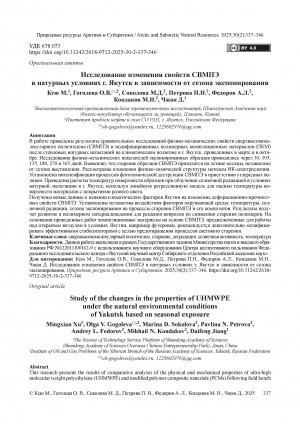
- 8. Ксю Мингсян, Гоголева Ольга Владимировна, Соколова Марина Дмитриевна, Петрова Павлина Николаевна, Федоров Андрей Леонидович, Кондаков Михаил Николаевич, Чжан Дайфен. Исследование изменения свойств СВМПЭ в натурных условиях г. Якутск в зависимости от сезона экспонирования = Study of the changes in the properties of UHMWPE under the natural environmental conditions of Yakutsk based on seasonal exposure
- 9. Природные ресурсы Арктики и Субарктики = Arctic and Subarctic natural resources, 2025, №2 (Т. 30)
Войдите в систему, чтобы открыть документ
QR-код документа

Как сканировать QR-код?
Для пользователей Android:
- Скачайте приложение для сканирования QR-кодов (Google Play)
- Откройте скачанное приложение;
- Наведите камеру на QR-код.
Для пользователей iPhone:
- Откройте приложение "Камера";
- Наведите камеру на QR-код;
- Нажмите на всплывающее уведомление.